1. Curating Differently:
Finding & Defining an Exhibition Concept
This exhibition evolved through a series of
chance encounters with ceramic objects; first at street markets and second-hand shops, and later on e-bay.
The first set of objects that inspired this project was a set of six (fondue/tapas?) plates decorated with such a glaze that seemed to preclude its domestic use, implied by the design of its form:

At the time, I thought that I may use the plates as part of a future art installation, and put them away.
A year later, I came across a vase, at a car boot sale. A brief search on the internet informed me that the vase had been made by the German firm Scheurich, probably during the 70s; that it was known to collectors as 'fat lava', and that it was quite cultish.
Although unremarkable in itself, the vase led me to make a connection with the spectacular blue plates and induced me to further investigate.
From this initial juxtaposition a dialogue ensued between the two, an exhibition concept evolved that would explore these unusual ('volcanic' or 'lava') glazes and the artistic context in which they were made.
It also seemed important to set these experiments — that are marginalised or ignored by ceramic histories — into a broad, international historical context.
Further searches and visits to museums (V & A, British Museum, Sèvres, etc.) and galleries revealed that the ceramic establishment in France, Germany and the UK had shown no interest in these works, which it regarded as inferior, and thus not worthy of attention alongside the 'higher' forms ('studio ceramics') that museums valued, collected and identified as significant.
This neglect confirmed that an exhibition showcasing popular, experimental and pioneering works from France and Germany was worth pursuing, and may extend the field of post-war ceramic history; especially in a country where the St Ives tradition had inhibited experiments with colors and textures that called upon sophisticated industrial chemical knowledge.
Comparing the ' fat lava' works I saw on the web site of Forrest Poston — a collector-dealer, in America, (and listening to his discussion of lava glazes)— with the intriguing set of blue plates, I had bought a year or so before (decorated with an outlandish blue 'lava'-type glaze which, at the time, I assumed had been made in the famous French pottery town of VALLAURIS), and had kept in their box as potential material for an art installation, I imagined a project that would bring together and explore
popular ceramics produced in GERMANY and FRANCE (both in
studios and
factories), that
experimented with glazes, (as part of a 'commercial' range) and defined a
new ceramic modernity against the views of traditionalist studio potters, like Bernard Leach, — known as 'the brown pot brigade' — who advocated a return to the East and to 17th century English slipware, and turned their back on the Continental Modernity that had started experimenting with glazes during the late 19th century!
The plates that inspired this project, alongside the Scheurich vase, were made during the 60s at the
Poterie du Cyclope, in ANNECY (France), by
Charles Cart, who evolved his distinctive new glazes by asking chemists to show him how to
'spoil' glazes.
Information about this small pottery was found on a web site which has, since, unfortunately disappeared.
My initial intention was to focus on works which defined a new modernity and made it available potentially to every home through ceramics.
This was achieved by combining
art, design and
craft skills with
serial production and
moderns modes and techniques of industrial or semi-industrial production.
Many studio potters also adopted serial production as a way of making their work available to as wide a number of people as possible, at affordable prices, and, in so doing, made their practice economically viable.
As the exhibition shows, the works of Wilhelm Kagel, Albert Kiessling, Heiner Hans Korting, Rudi and Wendelin Stahl, Gerhard Liebenthron, Kerstin Unterstab, among others, demonstrate that a ceramic practice could be both economically viable and produce works of quality and integrity, that were both modern and affordable.
This resolutely
modern and
democratic approach by German potters and ceramic manufacturers — inspired b y the Bauhaus — ran contrary to the exclusive, passeist and rarified
studio ceramics revival instigated by Bernard Leach in Britain; which, in elitist and anti-modern and modernist fashion (although inspired/animated by good intentions) claimed both the moral and the aesthetic high ground for itself.
COLLECTING
Many collectors of WGP (West German Pottery) buy everything they can find , if cheap enough, at car boot sales, charity shops, etc., and tend to accumulate as many pieces as possible, without much discrimination; letting
personal taste rule and a magpie approach take over. This is evident in the form of the
extensive displays it inspires.
Being able to identify the firm that produced items, the designer/s and the date seems to satisfy many collectors. Being able to sell some of the the pots on e-bay (to fuel their passion and 'de-clutter' their homes) seems also an incentive. Thus, many collectors of WGP are often dealers.
It seems that
enthusiasm for WGP has induced non-discriminating practices of collecting (intent on acquiring works by specific potters and factories; with the objective to fill or complete series (such as trying to collect all the different 'dekor' on a vase of the same 'form'/ design, and in finding 'rare' pots that can be sold at a 'hefty profit'), at the expense of developing 'critical' forms of collecting based on an appreciation of quality, and on an awareness of how these pots fit in an expanded ceramic history.
It seems that , for many collectors of WGP, TASTE is the guiding factor, rather than informed critical appreciation based on wider ceramic knowledge.
In Search of accidental masterpieces…
Just likes the Japanese tea-masters of the 17th century went in search of
accidental masterpieces at humble rural kilns, the challenge, today, for the
discriminating collector, is to
find modern industrial or studio equivalents. This, however, requires special skills to discriminate between the mass of 'ordinary' glazes (more or less competently applied, and often bearing the signs of a rushed, standardised industrial production; leaving little room for surprises) and find
distinctive ('extra-ordinary') examples of glazes, that bear the marks of
artistic skills,
flair during application, and (in many cases) the
gift of chance, produced during firing.
Looking closely at different versions of the same vase (in Germany:often bearing the same serial number), one notices enormous differences between two seemingly identical pieces; differences due to their actual execution and to the chemical reactions and transformations that occurred during firing.
Unfortunately many collectors-turned-ebay-sellers have established artificial
hierarchies and inflated
prices on the basis of arbitrary criteria informed by personal taste rather than on the actual properties and aesthetic qualities of the ceramics themselves.
This is reflected in the rudimentary language used to use describe the pots. Inflated adjectives like 'stunning', 'rare' and the likes, are used piecemeal to describe unremarkable, banal and gaudy pots.
This lack of engagement with quality (obscured by personal taste) and the
absence of critical tools (and of a sophisticated
critical language) to engage with
quality and with the
ceramic materiality of the works represent a major obstacle towards getting this area of ceramics taken seriously by curator and museums.
This exhibition emphasizes that one must be selective and learn to distinguish the good from the ordinary, and not be afraid to discard the bad and the mediocre. Quality is not just 'in the eyes of the beholder', and personal taste or enthusiasm are aleatoric and, ultimately irrelevant here.
Collecting for this Project
In November 2011, with no knowledge about German and French ceramics of the post war period — when 'lava'-type glazes were developed, and when Vallauris switched from producing domestic/cooking pots in 'terres vernissées' (earthenware pots coated with a simple green or yellow glaze), to the making of funky new decorative ceramics — but with a previous experience of collecting British and French Art pottery from the 1890 to the 1930s (and with an artistic eye for quality), I started roaming e-bay, searching under 'fat lava', 'Vallauris' and Annecy', 'Cyclope', 'Écume de mer', etc.
The first piece I bought was a vase by
Friedegard Glatzle, designed for
Karlsruhe Majolika Manufakture in 1960, and decorated with a subtle salmon pink
craquelée glaze, reminiscent of old Chinese glazes:
This was no 'fat lava', but represented a subtle integration of form and glaze which combined eastern and western tradition rather than confine itself to a pastiche of the East.
The first items I acquired were German ceramics of simple, elegant forms decorated with subtle glazes; not lava glazes:
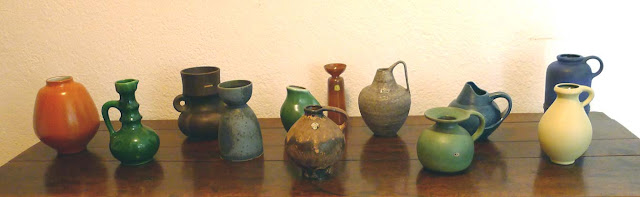
From Left to right: Karlsruhe Keramik Manufaktur, Jopeko, Otto Keramik (2), Ruscha (front), unidentified (green jug), glass candle holder (mistaken for a ceramic!), Silberdistel, Van Daalen, Wilhelm Kagel, Van Daalen, Steuler.
From various German dealers I acquired a varied selection of vases and jugs of different shapes and sizes by Wilhelm Kagel, made during the 50s and 60s, in the family workshop he took over in 1956, in Garmisch-Partenkirchen:

Unlike his father's works, which were decorated with painted flowers on a white ground, W. Kagel evolved his own style: an 'Art and Craft' for the present; a neo-traditionalism that has integrity and is not a mere pastiche of previous styles.
A close look at the forms reveals a subtle blend of references — to the Bauhaus and to traditional German stoneware — not a mean feat to achieve in earthenware. The decoration consists of simple patterns of lines sgraffitoed under a green, brown, yellow, orange or blue semi-matt glaze.
The large jug, in the center (above), is not by Kagel, but was made at the Steuler factory.
Slip-cast but hand-engraved and glazed, the jug holds its own among the hand-thrown studio pots; demonstrating that factory-produced ceramics are not necessarily inferior, as Bernard Leach had intimated.
Kagel's work is represented in the exhibition with a large jug that reinterprets historical forms; updating them for the present:
ENTERS
LE CYCLOPE
During the first month of the project I came across a small vase, on ebay, with a label which identified it as made by
Le Cyclope pottery in Annecy. This provided a third strand to explore (alongside
WGP and
Vallauris):
Around the same time I bought this vase, which seemed to come from the same pottery as the six plates that I had bought a year previously, and that were the seeds for this project:
A small web site with information about the Cyclope pottery in Annecy (which asked, à propos of a 'mystery' egg cup whether it was from Vallauris or from somewhere else) provided the only information I have been able to find about this pottery.
Unfortunately, this site is no longer on-line. When it was, however, it provided me with the only published information I have come across about this pottery (the information on the web site seems to have been collected from people who worked at or knew the pottery).
Visually the similarities with Vallauris 'écume de mer' glazes are strong.
An early vase by Le Cyclope (in the exhibition, case 18) carries an 'écume de mer' paper label, without naming the Cyclope pottery nor Annecy. This may have been an attempt to capitalise on the popularity of that Vallauris glaze (although it is quite different, and one see the signs of it evolving towards more defined 'craters' visible on the vase as well as on the blue plate, above).

As its name indicates, 'écume de mer' glazes emulate the 'froth of the sea'; as can be seen in this hand thrown vase, probably by FADY from Vallauris; unsigned but stamped 'tourné et décoré main' (hand-thrown and hand decorated) [The signature 'Fady' was usually applied on a paper sticker]:
Details of a the glaze on a conventional amphora style vase provide a good example of what 'écume de mer' consists of. Here the thick mineral (magma-like) glaze has been applied on the body of a vase of traditional form, leaving the neck and foot plain; coated with a semi-transparent glossy blue glaze, that was extensively used by Vallauris potters and factories.
These attributes closely resemble those of the 'Capri' glaze introduced in Germany by MAREI KERAMIK around 1967.
The exhibition explores experimentation in studio and factory-produced works, by setting up CERAMIC CONVERSATIONS between studio pots and factory-made ones, allowing their materialities to blurr the differences, and inviting us to appreciate their respective qualities without preconceptions.
…


